
Safety and Security... Bicycle Lighting
There is a legal requirement, as with all road going vehicles, for lights to be fitted and displayed during the hours of darkness. But having lights fitted to your bike is just common sense. They are an essential part of everyday cycling and can be considered to be an additional safety precaution even for daytime riding.
Lighting Types:
Bicycle lighting essentially takes one of the following forms:
- Standard battery filament bulb lights
- High Power Rechargeable headlights (Xenon, Halogen, HID and LED)
- LED (Light Emitting Diode) lights
- Dynamos
Standard battery filament bulb lights...
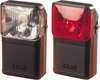
Some may be equipped with "brighter" bulbs but these types of light are generally fairly basic and not very economical to run. Even with Alkali type batteries, don't expect them to last much more than about 6 to 8 hours on a set of batteries. Front lamps tend to flatten their batteries slightly faster than rear lamps as the bulb would generally be of a higher wattage.
Some headlamps (better quality ones generally) run at 6volts (4 x AA cells), not 2.4volts (2 x C cells). These headlamps tend to last longer on a set of batteries for an almost identical cost per set of batteries.
Prices tend to range from about £5.00 up to about £30.00
Best used for infrequent dusk and night-time short rides.
High Power Rechargeable headlights (Xenon, Halogen, HID and LED)...
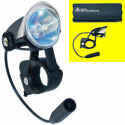
You can, however, find lights which are already equipped with rechargeable batteries when you buy. They can either be single light units with separate battery packs or, at the cheaper end of the scale they may be self contained units with integral batteries and charging circuits.
Recharcheable lights tend to only be front lights and either come bundled with a separate LED (see below) rear light or are sold separately.
Better quality lights will possibly feature brighter bulbs and more efficient battery packs. Some units may have more than one headlamp unit powered from a single battery pack.
Bulb Types:
- Standard Tungsten, Halogen or Xenon filament bulbs... are the commonest. Running at 2.4, 6 or 12 volt and up to 10W (Halogen).
- HID High Intensity Discharge bulbs... like the modern car headlights. These give a considerably brighter light output than a standard filament bulb, which much "whiter" light. Typically, considerably more expensive thanheadlights with traditional filament bulbs.
- LED Light Emitting Diode bulbs... in ultra high power form first appeared in 2005 and have been rapidly improving ever since. They output a light which is easily comparable to that of a HID unit and which offers best long term lifespan. High Power LED bulbs are available in small self contained headlamp units and larger external batteried systems.
Battery Types
Battery packs are the core of the systems. NiCads are used in the majority of the smaller self contained lights, but once you look at separate units, you may find lead acid, NiCad, NiMh or even Li-Ion batteries. The more expensive the system, generally the more efficient the battery.- Lead Acid - similar to the battery in your car, are very robust. They can be recharged at any time without major risk to the battery BUT they are heavy and bulky. They tend to be rectangular and can be awkward to attach to your bike, although they should come with a bag with which to fasten them to your frame. Most commonly mated to standard Xenon Tungsten or Halogen bulb headlights. Life expectancy 400-600 charges.
- NiCad - are the standard form of traditional rechargeable batteries. They generally give the equivalent power output as Lead Acid and are smaller and generally lighter. A standard NiCad cell is a typical round battery shape and an array of batteries can be fitted into a holder. These holders are commonly made to fit into a bottle cage mounted to your frame. NiCad batteries suffer from a phenomenon known as "memory". To keep them in good shape, they should always be fully discharged prior to recharging. Life expectancy 1000-1200 charges.
- NiMH - is the next generation after NiCad. The "memory" effect is almost totally removed however the power capacity is reduced from that of NiCad. Life expectancy 1000-1200 charges.
- Li-Ion - Lithium Ion batteries are predominantly used to power small electronics devices like mobile phones and laptop computers because they can store a tremendous amount of energy for their size and can be formed in non-cyclindrical shapes. This makes them smaller and lighter than an equivalent NiCad or NiMH but also substantially more expensive. No memory effect. Life expectancy 800-1000 charges.
Prices tend to range from about £20.00 up to about £400.00
Best used for regular commuting and longer night time rides.
LED (Light Emitting Diode) lights...
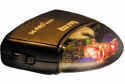
Initially, only rear lights were made with LED's owing to the lack of a "white" LED at a suitable cost. Early models featured constant light output and a pulsing output mode (flashing) but later models began to incorporate more noticeable flashing sequences.
Early front LED lights used yellow or green LEDs but these were not particularly popular. Recently, the white LED has become more affordable and has now made its' way into these lights.
Many cyclists know that the flashing LED offers greater visibilty and noticabilty to other road users.
Whether basic LEDs make suitable front lights is debateable. Unlike filament bulb lights, LEDs do not throw a beam of light which would sufficiently light up your path. LEDs are more about being seen that actually seeing. This is NOT true of the latest generation of High Power LEDs detailed above and refers only to the smaller reflector style/shaped LED lights
UK Law changed in 2005 to permit the use of "flashing" LED's. As a strange by-product of the revised laws, the standards are now more stringent for non-flashing LED's than they are for flashing ones!
There is even a completely battery-less lightset now, which leverages the changes in the law. It is powered by a solenoid which activates by magnets attached to your spokes. Each pass of the magnet causes a pulse of electrical charge to be generated in the solenoid which in turn makes the LED's in this clever item light up. It flashes as you ride... NO BATTERIES REQUIRED!
Prices tend to range from about £5.00 up to about £30.00
Best used for childrens bikes and any other type of riding. So economical to run you can leave them on regardless of the light conditions to aid being seen by other road users.
Dynamos...
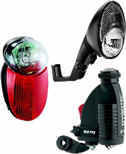
By far the most economical form of lighting, the dynamo has evolved quite dramatically over recent years.
The generator (dynamo) generally take one of two forms, either internal hub mounted or tyre drive bottles.
The hub dynamo is the more efficient and causes no drag because there is no friction BUT they are heavier and require specialist installation.
Tyre drive dynamos (bottle generators) simply rest against the side of the tyre and are driven via a rotating wheel which spins the dynamo armature.
What has changed most significantly with dynamo systems is the actual lights which are powered. The old problem with dynamos was that once you stopped, your lights went out, and at low speeds, insufficient energy would be generated to light the bulbs brightly enough.
Many better quality dynamo lights now feature a standby light feature. The lamp stores an amount of energy to keep the lamp lit for a period of time after the bike has stopped. This is commonly achieved by using LEDs as the standbys which are low power drain.
The real advantage of a dynamo is that you will never need to buy a battery for your lights again!
Prices tend to range from about £15.00 up to about £300.00
Best used for commuting and longer distance rides on road. NOT suitable for off road riding.